
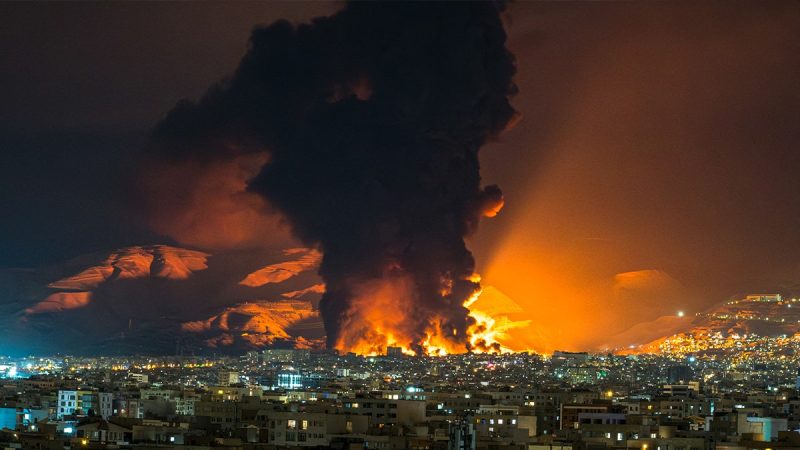
One week into the war with Iran, U.S. officials say American and Israeli forces are moving toward ‘complete control’ of Iranian airspace — clearing the way for deeper strikes, a broader target list and a conflict that appears to be expanding rather than winding down.
In briefings this week, Secretary of War Pete Hegseth and Joint Chiefs Chairman Gen. Dan Caine described what they called near-uncontested airspace over key corridors, a shift that allows sustained bombing operations deep inside Iran.
‘We are winning with an overwhelming and unrelenting focus on our objectives,’ Hegseth said in a press briefing Tuesday morning.
Caine said U.S. forces have now struck more than 5,000 targets in the first 10 days of operations, including dozens of deeply buried missile launchers hit with 2,000-pound penetrating bombs.
The message from Washington is one of overwhelming military advantage.
But the broader picture, rising oil prices, expanding drone warfare, strikes on energy and civilian infrastructure, and regional spillover touching NATO territory, suggests a conflict that is growing in scope even as U.S. officials project confidence in its trajectory.
Leadership hardens in Tehran
Amid the intensifying conflict, Iran’s Assembly of Experts has selected Mojtaba Khamenei — son of the recently deceased Ayatollah Ali Khamenei — as the country’s new supreme leader, consolidating authority within the clerical establishment and the Islamic Revolutionary Guard Corps at a pivotal moment.
The succession, only the second since the 1979 revolution, signals continuity rather than recalibration in Iran’s posture. Mojtaba Khamenei had long been viewed as a potential successor and is closely aligned with hard-line factions inside Iran’s security apparatus.
President Donald Trump criticized the selection, saying the leadership change would not alter U.S. objectives and suggesting it reflects the same entrenched power structure Washington has sought to weaken. The administration has made clear that military operations will continue regardless of who occupies the supreme leader’s office.
Rather than opening a diplomatic off-ramp, the transition appears to reinforce the likelihood of a prolonged confrontation.
‘Uncontested airspace’
Hegseth said Tuesday that the U.S. and Israel had achieved ‘total air dominance’ over Iran and were ‘winning decisively with brutal efficiency.’
‘That doesn’t mean they won’t be able to project,’ Hegseth said. ‘It doesn’t mean our air defenders still don’t have to defend. They do. But that is strong evidence of degradation.’
‘Most of their higher-end surface-to-air missile systems are not factors at this point in time,’ Caine said.
‘Fighters are moving deeper with relative impunity,’ he added, noting there is ‘always some risk.’
Adm. Brad Cooper, head of the U.S. military’s Central Command, also reported that Iranian ballistic missile launches had dropped by roughly 90% from the opening days of the conflict, while drone attacks had fallen by more than 80%, attributing the decline to sustained strikes on launchers and infrastructure.
Still, officials have cautioned that air superiority does not mean every threat can be stopped. Iranian missiles and drones continue to be launched, and some have required interception across the region.
A shift in munitions and message
Hegseth said the campaign is transitioning from expensive standoff weapons like Tomahawk cruise missiles to 500-, 1,000- and 2,000-pound precision gravity bombs — a shift he said reflects confidence that Iranian surface-to-air missile systems have been suppressed in key areas.
He described the U.S. stockpile of such bombs as ‘nearly unlimited’ and warned that Washington’s timeline ‘is ours and ours alone to control.’
The emphasis on gravity bombs is more than rhetorical. It signals a move toward sustained, high-tempo operations designed not only to hit active threats but to degrade Iran’s ability to regenerate its missile force.
Drones redefine the fight
Even as missile launches decline, unmanned systems remain central to the war.
Iran has leaned heavily on drones — including Shahed-style loitering munitions — to strike energy facilities, pressure U.S. bases and disrupt shipping near the Strait of Hormuz. Compared to ballistic missiles, drones are cheaper and easier to deploy in volume, allowing Tehran to sustain pressure despite losses elsewhere.
In response, the United States has deployed a Ukraine-tested counter-drone interceptor system to the region. Ukrainian specialists, drawing on experience defending against Iranian-designed drones used in the Russia-Ukraine war, are assisting in strengthening base protection.
The drone fight underscores a key dynamic: while U.S. forces may dominate the skies, lower-cost unmanned systems can still impose risk and strain air defenses.
Energy at risk
The Strait of Hormuz — through which roughly 20% of the world’s oil and major liquefied natural gas shipments transit — has become one of the most consequential flashpoints of the war.
Drone attacks and Iranian threats sharply have reduced commercial traffic, driving up insurance costs and forcing some vessels to reroute. Oil prices have climbed above $100 per barrel amid fears that disruptions could persist.
Israeli strikes on Iranian oil facilities, and Iran’s retaliatory targeting of regional energy infrastructure, signal that energy assets are now active targets. Reports of strikes affecting water and desalination plants further suggest the war is expanding beyond strictly military sites.
If instability in Hormuz stretches for weeks, analysts warn, global energy markets could tighten quickly, translating into higher gasoline prices and renewed inflation pressure in the United States.
Trump warned Monday that Iran will be hit ’20 times harder’ than it already has if it threatens ships in the Strait.
NATO proximity and regional backlash
The war has edged closer to NATO territory. Two Iranian ballistic missiles were intercepted near Turkish airspace, raising the risk of broader alliance involvement.
Iran has also struck Azerbaijan, drawing sharp condemnation from Baku and angering Turkey, Azerbaijan’s closest ally. Notably, Iran has not seen a unified regional bloc mobilize in its defense, highlighting its relative diplomatic isolation even as it escalates militarily.
Industrial mobilization
Despite Hegseth’s assertion that certain offensive munitions are plentiful, sustaining air and missile defense operations is resource-intensive, and inventories of high-end interceptors were already under strain before the conflict began.
Iran has attempted to degrade radar systems tied to platforms such as THAAD and Patriot batteries. While U.S. commanders say launch rates have declined sharply, interceptors are expensive and produced in limited quantities.
Trump convened major defense contractors last week to press for accelerated production of interceptors and related systems. Expanding output could require congressional funding if the campaign continues at its current pace.
The battlefield now extends beyond launch sites and into supply chains.
Rising casualties
The Pentagon has confirmed seven U.S. service members have been killed and eight seriously injured in Iranian strikes.
In Iran, the U.S. claims over 50 top Iranian leaders, including Supreme Leader Ali Khamenei, have been taken out. Iran claims more than 1,000 people have been killed in the strikes and approximately 175 people, including many schoolchildren, were killed in an attack on a girls’ elementary school in Minab.
No group has claimed responsibility, and investigations are ongoing.
The incident has intensified scrutiny over civilian protection as the conflict widens.
No quick off-ramp
A little more than one week in, the trajectory points toward expansion rather than containment.
U.S. officials project confidence in air dominance and sustained strike capacity. Iranian leadership has consolidated under a hard-line successor. Energy markets are volatile. Drone warfare continues to test defenses. The conflict has brushed NATO territory and struck civilian infrastructure.
The central question is how far the conflict will spread, and whether military momentum can outpace the economic and geopolitical costs mounting across the region.