
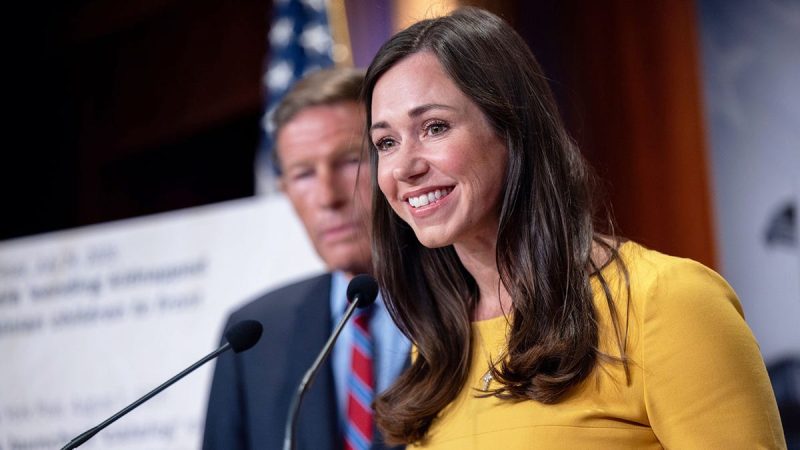
One Senate Republican proved that it’s still possible to bridge the chasm between the aisles after brokering an end to the longest government shutdown in history.
The 43-day impasse in Congress may have ended in the House, but it was in the Senate that Sen. Katie Britt, R-Ala., worked to build an old-fashioned bipartisan coalition to jump-start the stalled chamber.
It took several weeks, numerous conversations and reconstructing broken trust between Senate Republicans and Democrats to pull off what would become a bipartisan package to reopen the government.
And it was something that Britt, in an interview with Fox News Digital, contended she was uniquely positioned to do.
She was chief of staff for former Sen. Richard Shelby, R-Ala., and knew how the sausage was made in the upper chamber. She also had longstanding relationships with some of the key Democratic negotiators, like Sen. Jeanne Shaheen, D-N.H., who ultimately joined most Republicans to reopen the government.
For Britt, who chairs the Homeland Security Appropriations Committee, the key to reopening the government was funding the government through spending bills.
‘I’m very grateful for those on the other side of the aisle that had the courage to step forward and say, you know, we’re not going to allow everyday Americans to suffer as a result of keeping this government closed,’ she said. ‘I do think what we saw was a lot of people that were listening to their political consultants instead of the actual constituency that they serve.’
‘Because clearly, I think a lot of people had lost sight of the fact that we were in this place because we hadn’t passed appropriations bills,’ Britt continued.
During the last session of Congress, the chambers were split. Republicans held a tenuous grip on the House while Schumer and Senate Democrats controlled the Senate. Many of the spending bills produced by the House were often partisan, while the bipartisan bills crafted in the Senate never made it to the floor.
‘If you look back over Senator Schumer’s tenure as leader and over the last two years, he didn’t even put one bill on the floor last year, which is what led us to this posture of a CR to start with,’ she said.
Britt believed that at least moving a trio of spending bills could perhaps unstick the gears in the Senate and get lawmakers closer to ending the shutdown. Whether that package of bills could end up attached to legislation to reopen the government, however, remained elusive.
While she lauded both Senate Appropriations Chair Susan Collins, R-Maine, and Senate Majority Leader John Thune, R-S.D., for their roles in ensuring the funding process actually worked, her role as de facto arbiter began roughly three weeks before the shutdown ended.
One of the main issues before and throughout the shutdown was a lack of trust that Senate Democrats had in Republicans, an issue that was reaffirmed when the GOP voted to claw back billions in congressionally approved funding earlier in the year.
That trust issue was further solidified due to a lack of commitments from Republicans to prevent the Trump administration from continuing to carve away at federal funding with impoundments and rescissions.
And the key moment that saw the wheels begin to move in the direction of reopening came when Senate Democrats blocked the Defense appropriations bill, which would have paid service members among a plethora of other things.
‘The question that I had for each of them, you know, why? This came out of committee in a bipartisan way, and it was clear, they wanted greater conversation around how we were planning on moving these things forward,’ she said.
It was from those informal talks that she leaned into speaking with more Democratic lawmakers to try and assuage their concerns about what would happen during and after the spending bills were passed. Those conversations brought her all the way to Senate Minority Leader Chuck Schumer, D-N.Y., on whether he would approve of the appropriations process moving forward.
‘Taking a cue from that is why I really leaned into conversations, both with people that I believed were gettable in finding a pathway forward on reopening the government and those who were not,’ she said. ‘You know, just saying, like, ‘Look, guys, here’s what we’re going to do. We’re going to work to fund these three bills. And if we do that, you know, here will be the ultimate result of it.’’
But, as with any successful legislation, there’s always a numbers game.
Not every Senate Republican was in favor of reopening the government, or at least the vehicle to do so, a point Britt reiterated often. Sen. Rand Paul, R-Ky., had consistently voted against the House-passed bill until that point.
So that meant she needed to find the numbers elsewhere across the aisle. Shaheen, who was leading negotiations for Senate Democrats, largely had her numbers in check, but there was one more that needed an extra nudge: Sen. Tim Kaine, D-Va.
Over the course of 48 hours, the weekend of the penultimate vote to seal the deal in the Senate, Kaine went from being against the package to supporting it. Britt acted as a liaison to the White House, bringing Kaine’s demands that the administration roll back firings carried out during the shutdown and provide protections to federal workers, which the administration ultimately agreed to.
But ending the shutdown was the first hurdle. Lawmakers now have until Jan. 30, 2026, to fund the government. Britt said she would keep doing what she’s been doing: talking to the other side.
‘I am hopeful that people will remember what we’re supposed to be doing, and that is working to pass these bills,’ she said. ‘And I am sure that there will be challenges in front of us, but you know, having dialogue and working to break the logjam will be essential when it does occur to keep America moving.’