
For years, California Gov. Gavin Newsom has reaped the benefits of Silicon Valley’s AI boom — in the form of tax revenue for his state and political contributions from industry leaders.
Newsom’s interests often aligned with those of tech titans, and he largely protected those interests. In 2024, for example, he vetoed a bill that would have created legal liabilities for artificial intelligence companies in the event of catastrophes involving terrorism, mass casualties or other damage to society. It would also have required the companies to maintain kill switches so that AI processes could be turned off.
Newsom has long talked about the need to find a practical balance between utopian corporate visions of AI’s upsides and dystopian populist nightmares of human subservience to machines.
“Given the stakes — protecting against actual threats without unnecessarily thwarting the promise of this technology to advance the public good — we must get this right,” he said in his veto message.
But as he lays the groundwork for a widely anticipated 2028 presidential bid, Newsom is shifting his weight away from the corporate end of the balance and toward the populist end. The move could have implications not only for the Democratic nomination fight, but also in a general election, as the political left and right have coalesced around concerns about AI driving up costs to consumers and posing threats to liberty, cybersecurity and physical safety.
The issue has bedeviled elected officials in both parties at the federal and state levels.
They are clearly feeling heat from the public over a wide variety of AI-related issues, from potential job losses, the expensive energy demands of data centers and sexual exploitation, to more abstract fears of Americans’ lives being run by a handful of the rich and powerful through the use of advanced machines.
On the other side, tech giants bring in money — and spend lavishly on campaigns — and national security experts warn that unilateral disarmament in the AI arms race is a recipe for disaster.
Last week, President Donald Trump scuttled his own planned executive order on AI regulation at the last minute, citing concerns that it might “get in the way” of the country’s ability to compete with China.
At the same time, Newsom is using his power as California’s chief executive to begin rolling out initiatives to beef up AI controls.
Jason Elliott, a policy-minded political consultant who served as Newsom’s deputy chief of staff, said the governor has had his hands deep in AI policy, whether it’s the frontier-safety law he backed last year — which requires major AI developers to identify and mitigate risks before deploying their products — or the legislation he vetoed the year before.
“Just because you can name a problem and take a problem very seriously doesn’t mean that every single solution someone proposes is proper,” Elliott said. “I have never seen an issue move as quickly as AI, and it’s not even close. So every elected official’s position naturally should be evolving on AI from week to week and month to month, because the underlying technology itself seems to change every day.”
Newsom is evolving in real time, to the delight of some progressives who believed he was dragging his feet on behalf of corporations and donors.
Last week, Newsom signed an executive order requiring state agencies to work with industry groups, academics and organized labor to develop plans for assessing and offsetting AI’s effects on California workers.
“The whole system has to be reimagined, and we’re not — I don’t think we’re having an accelerated or advanced conversation right now; we’re still discussing who’s going to pay for my increased electricity because of the data center, which is a legit issue,” Newsom said at a May 19 conference convened by the liberal think tank Center for American Progress in Washington. “But it’s not the issue, and … the tech genie is not going to go back in the bottle.”
Newsom also submitted a revised state budget proposal this month that would vastly increase antitrust enforcement dollars, which have been used to go after companies that use algorithms to set prices.
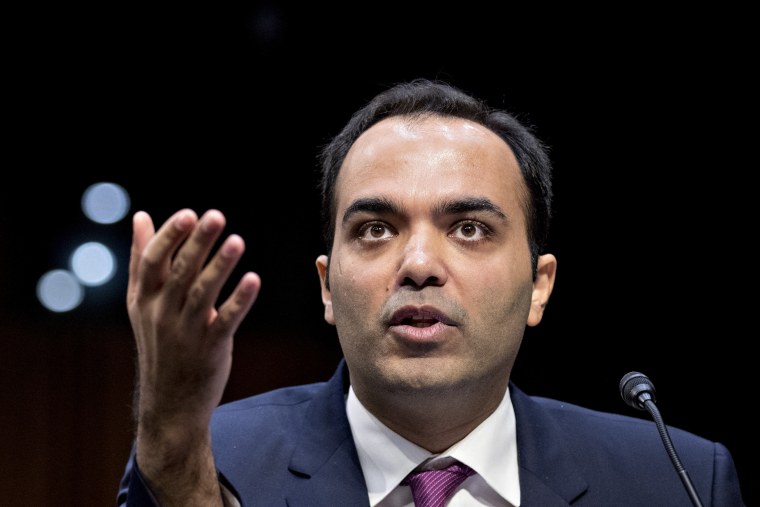
Earlier this month, he hired former Consumer Financial Protection Bureau chief Rohit Chopra, who has warned about potential excesses of AI, to head up a state business and consumer services agency. And, along with other prospective 2028 candidates, according to Axios, Newsom has been cozying up to Sen. Elizabeth Warren, D-Mass., who is among the loudest critics of AI’s economic implications.
Among the large crop of prospective 2028 hopefuls, there is a broad spectrum of views on AI and its various uses — and some uncertainty about when and how to regulate them. Data centers, which represent just a slice of AI policy, have become a flashpoint for voters and an area of attention for policymakers with White House ambitions.
Pennsylvania Gov. Josh Shapiro, for example, is tying accelerated permits for data centers to companies’ willingness to pay for power, provide workforce protections and conserve the environment. Rep. Alexandria Ocasio-Cortez, D-N.Y., has called for a moratorium on data centers and pressed federal officials on their impact on drinking water.
Like Newsom, Illinois Gov. JB Pritzker, who is also widely considered to be looking at a 2028 bid, is moving to demonstrate a more cautious approach to AI. In February, he proposed a two-year pause on tax incentives for building data centers.
A YouGov/Economist poll this month found that 71% of Americans — 77% of Democrats and 68% of Republicans — say AI development is “moving too fast.”
“It should be clear to anyone paying attention to polling or even just vibes that there is a lot of voter-level concern about AI and costs and who the economy is serving and who the economy isn’t serving,” Dan Geldon, a former top aide to Warren, said. “It makes sense that Newsom and other candidates would open channels with populists and consider their ideas in this environment.”
But revenue from “hyperscalers” — tech companies that build data centers to handle massive amounts of information — is attractive to many state executives in both parties.
“We’re looking at literally hundreds of millions of dollars annually to local government, cities, counties and school districts that the hyperscaler is going to pay in their fee and loop payments,” Mississippi Gov. Tate Reeves, a Republican who has welcomed data center investments from Amazon, xAI and other major players into his state, said in a recent interview.
And yet there are Republican governors who have taken a much more skeptical view of AI and of data centers.
Florida Gov. Ron DeSantis, a Republican, has pushed unsuccessfully to enact an AI “bill of rights” that would protect data privacy and prevent insurance companies from judging claims based on machine-dictated decisions. Like Reeves, he signed a law requiring hyperscalers to pay utility costs associated with their work.
For 2028 hopefuls in both parties, the opportunities and risks of developing AI policies at machine-learning speed are becoming more clear. For Newsom, there’s been a perceptible shift toward the populist leanings of the progressive wing of his party.
Elliott, his former aide, said it makes sense on a public policy level for the governor to keep up with changes in technology and adjust his response accordingly.
“It’s true that Gov. Newsom has continued to observe the state of the industry, the state of technology, and then update his perspectives as the industry moved forward,” Elliott said. “Republicans are doing the same thing and should be doing the same thing and there are a number of Republicans around the country who are taking the very hands-on approach to regulating artificial intelligence.”