
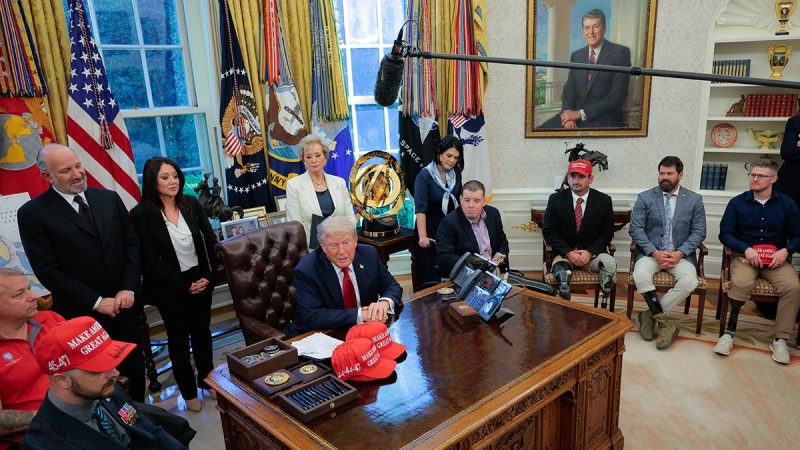
President Donald Trump spent the first year of his second White House term signing a torrent of executive orders aimed at delivering on several major policy priorities, including slashing federal agency budgets and staffing, implementing a hard-line immigration crackdown and invoking emergency authority to impose steep tariffs on nearly every U.S. trading partner.
The pace of Trump’s executive actions has far outstripped that of his predecessors, allowing the administration to move quickly on campaign promises. But the blitz has also triggered a wave of lawsuits seeking to block or pause many of the orders, setting up a high-stakes confrontation over the limits of presidential power under Article II and when courts can — or should — intervene.
Lawsuits have challenged Trump’s most sweeping and consequential executive orders, ranging from a ban on birthright citizenship and transgender service members in the military to the legality of sweeping, DOGE-led government cuts and the president’s ability to ‘federalize’ and deploy thousands of National Guard troops.
Many of those questions remain unresolved. Only a few legal fights tied to Trump’s second-term agenda have reached final resolution, a point legal experts say is critical as the administration presses forward with its broader agenda.
Trump allies have argued the president is merely exercising his powers as commander in chief.
Critics counter that the flurry of early executive actions warrants an additional level of legal scrutiny, and judges have raced to review a crushing wave of cases and lawsuits filed in response.
WINS:
Limits on nationwide injunctions
In June 2025, the Supreme Court sided with the Trump administration 6-3 in Trump v. CASA, a closely watched case centered on the power of district courts to issue so-called universal or nationwide injunctions blocking a president’s executive orders.
Though the case ostensibly focused on birthright citizenship, arguments narrowly focused on the authority of lower courts’ ability to issue nationwide injunctions and did not wade into the legality of Trump’s order, which served as the legal pretext for the case. The decision had sweeping national implications, ultimately affecting the more than 310 federal lawsuits that had been filed at the time challenging Trump’s orders signed in his second presidential term.
Justices on the high court ultimately sided with U.S. Solicitor General John Sauer, who had argued to the court that universal injunctions exceeded lower courts’ Article III powers under the Constitution, telling justices that the injunctions ‘transgress the traditional bounds of equitable authority,’ and ‘create a host of practical problems.’
The Supreme Court largely agreed. Justices ruled that plaintiffs seeking nationwide relief must file their lawsuits as class action challenges. This prompted a flurry of action from plaintiffs in the weeks and months that followed as they raced to amend and refile relevant complaints to lower courts.
Firing independent agency heads
The Supreme Court also signaled openness to expanding presidential authority over independent agencies.
Earlier in 2025, the justices granted Trump’s request to pause lower-court orders reinstating two Democratic appointees — National Labor Relations Board (NLRB) member Gwynne Wilcox and Merit Systems Protection Board (MSPB) member Cathy Harris, two Democrat appointees who were abruptly terminated by the Trump administration. It also suggested the Supreme Court is poised to pare back a 90-year-old precedent in Humphrey’s Executor, a 1935 ruling that prohibits certain heads of multi-member, congressionally created federal regulatory agencies from being fired without cause.
It is not the only issue in which the justices appeared inclined to side with Trump administration officials and either overturn or pare back Humphrey’s protections.
In December, the Supreme Court heard oral arguments in Trump v. Slaughter, a similar case centered on Trump’s attempt to fire a member of the Federal Trade Commission without cause. Justices seemed likely to allow the firing to proceed and to weaken Humphrey’s protections for similarly situated federal employees, though the extent that justices will move to dilute an already watered-down court ruling remains unclear.
The high court will also review another case centered on Trump’s ability to remove Federal Reserve Board Governor Lisa Cook early in 2026.
LOSSES:
Tariffs
While it’s rarely helpful to speculate on how the Supreme Court might rule on a certain case, court watchers and legal experts overwhelmingly reached a similar consensus after listening to oral arguments in Learning Resources v. Trump, the case centered on Trump’s use of an emergency wartime law to enact his sweeping tariff plan.
At issue in the case is Trump’s use of the International Emergency Economic Powers Act (IEEPA) to enact his steep 10% tariffs on most imports. The IEEPA law gives the president broad economic powers in the event of a national emergency tied to foreign threats. But it’s unclear if such conditions exist, as voiced by liberal and conservative justices in their review of the case earlier in 2025.
Several justices also noted that the statute does not explicitly reference tariffs or taxes, a point that loomed large during oral arguments.
A ruling against the administration would deliver a major blow to Trump’s signature economic policy.
Court watchers and legal experts said after arguments that a Trump administration win could be more difficult than expected, though each cautioned it is hard to draw conclusions from roughly two hours of oral arguments, a fraction of the total time justices spend reviewing a case.
Jonathan Turley, a law professor and Fox News contributor, said in a blog post that the justices ‘were skeptical and uncomfortable with the claim of authority, and the odds still favored the challengers.’
‘However, there is a real chance of a fractured decision that could still produce an effective win for the administration,’ Turley added.
Brent Skorup, a legal fellow at the CATO Institute, told Fox News Digital in an emailed statement that members of the court seemed uncomfortable with expanding presidential power over tariffs.
‘Most justices appeared attentive to the risks of deferring to a president’s interpretation of an ambiguous statute and the executive branch ‘discovering’ new powers in old statutes,’ Skorup said.
Birthright citizenship
The Supreme Court has agreed to review Trump’s executive order restricting birthright citizenship, one of the most legally consequential actions of his second term.
At issue is an executive order Trump signed on his first day back in office that would deny automatic U.S. citizenship to most children born to illegal immigrant parents or parents with temporary legal status, a sweeping change critics say would upend roughly 150 years of constitutional precedent.
The order immediately sparked a flurry of lawsuits in 2025 filed by dozens of U.S. states and immigrants’ rights groups. Opponents have also argued that the effort is an unconstitutional and ‘unprecedented’ one that would threaten some 150,000 children in the U.S. born annually to parents of noncitizens and an estimated 4.4 million American-born children under 18 who are living with an illegal immigrant parent, according to data from the Pew Research Center.
To date, no court has sided with the Trump administration’s interpretation of the 14th Amendment, though multiple district courts have blocked the order from taking force.
While it’s unclear how the high court might rule, the lower court rulings suggest the Trump administration might face a steep uphill battle in arguing the case before the Supreme Court in early 2026.
The court said in early December it will hold oral arguments in the case in 2026, between February and April, with a ruling expected by the end of June.