
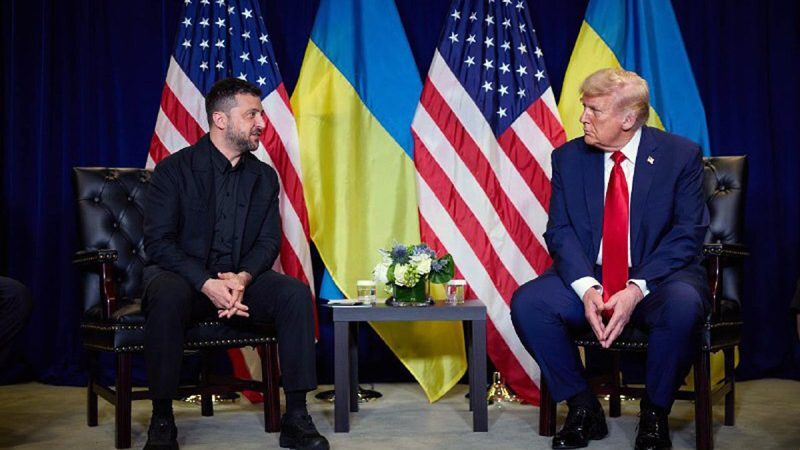
President Donald Trump spent much of 2025 attempting what had eluded his predecessors: personally engaging both Russian President Vladimir Putin and Ukrainian President Volodymyr Zelenskyy in an effort to bring an end to the war in Ukraine. From high-profile summits to direct phone calls, the administration pushed for a negotiated settlement even as the fighting ground on and the map changed little.
By year’s end, the outlines of a potential deal were clearer than they had been at any point since Russia’s full-scale invasion, with U.S. and Ukrainian officials coalescing around a revised 20-point framework addressing ceasefire terms, security guarantees and disputed territory. But 2025 also made clear why the war has proven so resistant to resolution: neither battlefield pressure, economic sanctions nor intensified diplomacy were enough to force Moscow or Kyiv into concessions they were unwilling to make.
The Trump administration’s push for a deal
The year began with a high-profile fallout last February between President Donald Trump, Vice President JD Vance and Ukrainian President Volodymyr Zelenskyy, when the Ukrainian leader stormed out of the White House after Trump told him he did not have ‘any cards’ to bring to negotiations with Russia.
Frustrated by the pace of talks after promising to end the war on ‘Day One’ of his presidency, Trump initially directed his ire toward Zelenskyy before later conceding that Moscow, not Kyiv, was standing in the way of progress.
‘I thought the Russia-Ukraine war was the easiest to stop but Putin has let me down,’ Trump said in September 2025.
That frustration had already surfaced publicly months earlier as Russian strikes continued despite diplomatic engagement. ‘He talks nice, and then he bombs everybody in the evening,’ Trump said in July.
Trump’s outreach to Russian President Vladimir Putin culminated in a high-profile summit in Alaska in August, though additional meetings were later called off amid a lack of progress toward a deal.
Still, Trump struck a more optimistic tone toward the end of the year. On Sunday, after meeting Zelenskyy at Mar-a-Lago, the president said the sides were ‘getting a lot closer, maybe very close’ to a peace agreement, while acknowledging that major obstacles remained — including the status of disputed territory such as the Donbas region, which he described as ‘very tough.’
Trump said the meeting followed what he described as a ‘very positive’ phone call with Putin that lasted more than two hours, underscoring the administration’s continued effort to press both sides toward a negotiated end to the war.
Where negotiations stand now
By the end of 2025, the diplomatic track had narrowed around a more defined — but still contested — framework. U.S. officials and Ukrainian negotiators have been working from a revised 20-point proposal that outlines a potential ceasefire, security guarantees for Ukraine, and mechanisms to address disputed territory and demilitarized zones.
Zelenskyy has publicly signaled openness to elements of the framework while insisting that any agreement must include robust, long-term security guarantees to deter future Russian aggression. Ukrainian officials have also made clear that questions surrounding occupied territory, including parts of the Donbas, cannot be resolved solely through ceasefire lines without broader guarantees.
Russia, however, has not agreed to the proposal. Moscow has continued to insist on recognition of its territorial claims and has resisted terms that would constrain its military posture or require meaningful concessions. Russian officials have at times linked their negotiating stance to developments on the battlefield, reinforcing the Kremlin’s view that leverage — not urgency — should dictate the pace of talks.
The result is a negotiation process that is more structured than earlier efforts, but still far from resolution: positions have hardened even as channels remain open, and talks continue alongside ongoing fighting rather than replacing it.
Russia’s territorial pressure — and Ukraine’s limited gains
Even as diplomacy intensified in 2025, the war on the ground remained defined by slow, grinding territorial pressure rather than decisive breakthroughs. Russian forces continued pushing for incremental gains in eastern and southern Ukraine, particularly along axes tied to Moscow’s long-stated objective of consolidating control over territory it claims as Russian.
Russian advances were measured and costly, often unfolding village by village through artillery-heavy assaults and sustained drone use rather than sweeping offensives. While Moscow failed to capture major new cities or trigger a collapse in Ukrainian defenses, it expanded control in parts of eastern and southern Ukraine, maintaining pressure across multiple fronts and keeping territorial questions central to both the fighting and any future negotiations.
Ukraine, for its part, did not mount a large-scale counteroffensive in 2025 comparable to earlier phases of the war. Ukrainian forces achieved localized tactical successes, at times reclaiming small areas or reversing specific Russian advances, but these gains were limited in scope and often temporary. None translated into a sustained territorial breakthrough capable of altering the broader balance of the front.
Instead, Kyiv focused on preventing further losses, reinforcing defensive lines and imposing costs on Russian forces through precision strikes and asymmetric tactics. With decisive territorial gains out of reach, Ukraine expanded attacks against Russian energy infrastructure, targeting refineries, fuel depots and other hubs critical to sustaining Moscow’s war effort — including sites deep inside Russian territory.
Russia, meanwhile, continued its own campaign against Ukraine’s energy grid, striking power and heating infrastructure as part of a broader effort to strain Ukraine’s economy, civilian resilience and air defenses. The result was a widening pattern of horizontal escalation, as both sides sought leverage beyond the front lines without achieving a decisive military outcome.
The result was a battlefield stalemate with movement at the margins: Russia advanced just enough to sustain its territorial claims and domestic narrative, while Ukraine proved capable of blunting assaults and imposing costs but not of reclaiming large swaths of occupied land. The fighting underscored a central reality of 2025 — territory still mattered deeply to both sides, but neither possessed the military leverage needed to force a decisive shift.
That dynamic would increasingly shape the limits of diplomacy. Without a major change on the battlefield, talks could test red lines and clarify positions, but not compel compromise.
Why talks stalled: leverage without decision
For all the diplomatic activity in 2025, negotiations repeatedly ran into the same obstacle: neither Russia nor Ukraine faced the kind of pressure that would force a decisive compromise.
On the battlefield, Russia continued to absorb losses while pressing for incremental territorial gains, reinforcing Moscow’s belief that time remained on its side. Ukrainian forces, though increasingly strained, succeeded in preventing a collapse and in imposing costs through deep strikes and attacks on Russia’s energy infrastructure — demonstrating an ability to shape the conflict even without major territorial advances.
Economic pressure also reshaped — but did not determine — Moscow’s calculus. Despite years of Western sanctions, Russia continued financing its war effort in 2025, ramping up defense production and adapting its economy to sustain prolonged conflict. While sanctions constrained growth and access to advanced technology, they raised the long-term costs of the war without producing the immediate pressure needed to force President Vladimir Putin toward concessions.
Those realities defined the limits of U.S. mediation. While the Trump administration pushed both sides to clarify red lines and explore possible frameworks for ending the war, Washington could illuminate choices without dictating outcomes, absent a decisive shift on the ground or a sudden change in Moscow’s calculations.
The result was a year of talks that clarified positions without closing gaps. As long as pressure produced pain without decision, negotiations could narrow options and define boundaries, even if they could not yet bring the conflict to an end.